7 Simple Nutrition Tips That Actually Make a Difference
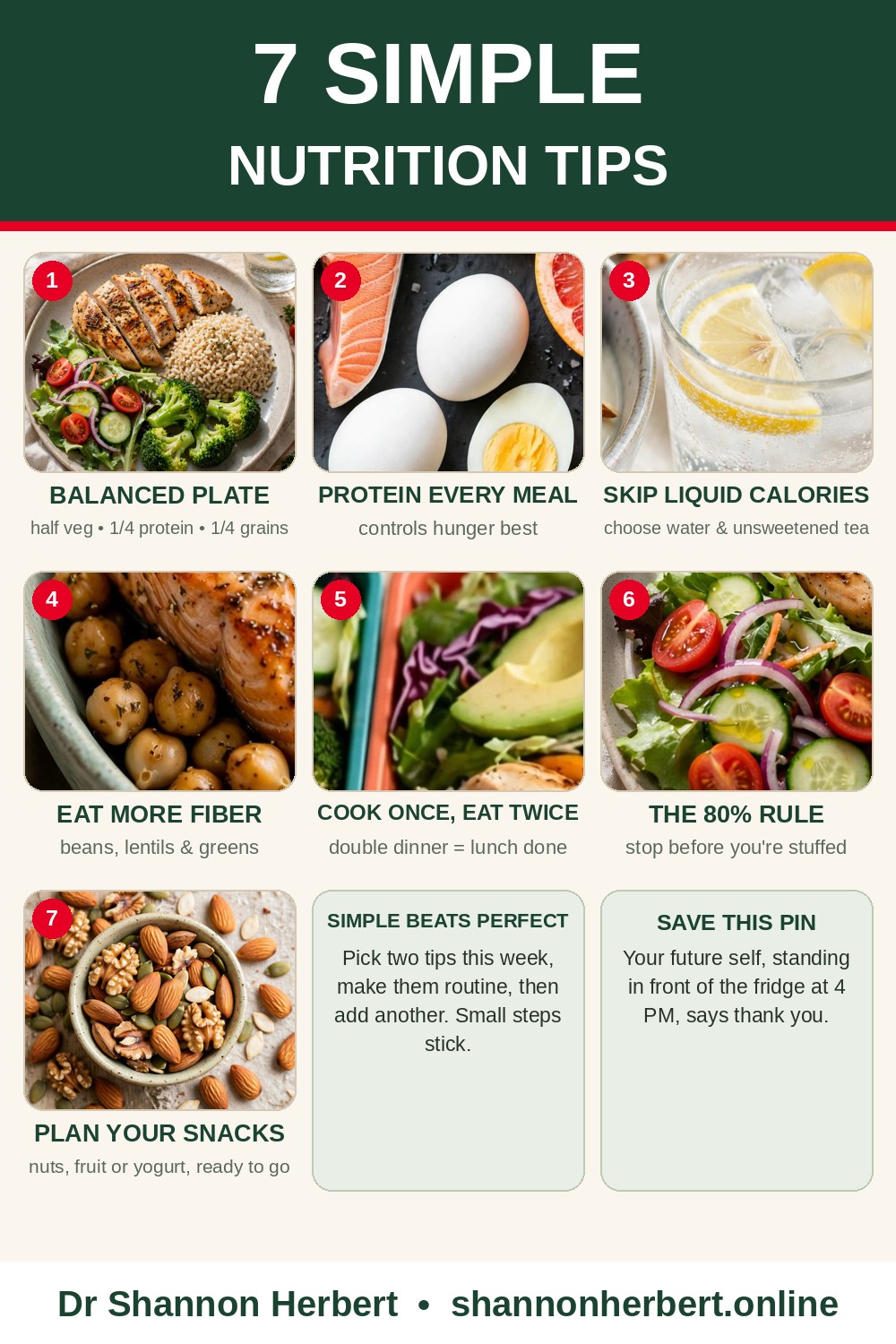
6. Keep the 80% Rule
Eat until you are about 80% full, then stop. It takes practice, and it is one of the simplest portion tools in the world — no scale required. The idea comes from Okinawa, one of the places famous for long, healthy lives, where the phrase hara hachi bu — eat until you are eight parts full — is said before meals like a small prayer.
The physiology is on its side. Fullness signals travel from stomach to brain with a delay of roughly 20 minutes. If you eat until you feel completely full, you have almost always overshot: twenty minutes later you feel stuffed, because the last portion registered after you swallowed it. Stopping at 80% — comfortably satisfied, could eat more but do not need to — usually lands you at genuinely full right around the time the plate would have been empty anyway.
How to practice it:
- Serve yourself a normal portion, then eat slowly enough for signals to keep up — this tip is impossible at high speed
- At about the three-quarter mark, pause. Put the fork down, take a breath, and ask: am I still hungry, or just still eating?
- If you are truly still hungry in 15 minutes, eat a little more. The rule is a calibration tool, not a hunger strike
Common mistake: Using the 80% rule as an excuse to chronically under-eat, or pairing it with tiny “diet” portions that were never adequate to begin with. It applies to normal, balanced meals — the kind built by tips 1 and 2. Applied to a proper meal, it trims the overshoot. Applied to an already-small meal, it just makes the meal smaller, and the snack drawer wins again.
Make it easier: Smaller plates genuinely help here, not as a trick but as a portion anchor — a reasonable serving looks generous on a smaller plate and lost on a huge one, and your sense of “a portion” quietly follows the visual.
7. Plan the Snack Before the Snack Plans You
A small planned snack — nuts, fruit, yogurt — beats the unplanned biscuit run every time. Snacking itself is not the problem. Most adults snack; the difference between people who manage their weight comfortably and people who struggle is rarely whether they snack. It is what the snack is and whether it was chosen in advance.
An unplanned snack is chosen at your hungriest, tiredest moment, from whatever is nearest — which in most offices and kitchens means biscuits, chips, and the vending machine. A planned snack is chosen by the calm, morning version of you, and it is sitting there waiting when the 4 PM moment arrives. Same person, same willpower, completely different outcome — because the decision was moved to a better moment.
Good standing snacks (keep 2–3 stocked):
- A small handful of nuts (about 1 oz / 28 g) — satisfying, portable, no refrigeration
- Greek yogurt with berries
- An apple or pear with a tablespoon of peanut butter
- Hummus with vegetable sticks or a small whole-grain pita
- A boiled egg with salt and chili flakes
- Edamame, roasted chickpeas, or a small piece of cheese with fruit
Common mistake: Buying “snack packs” of biscuits and crackers in the name of portion control, then eating three packs. Portion-controlled packaging only works if the food itself is satisfying; protein, fiber, and fat satisfy — refined starch and sugar mostly schedule the next snack.
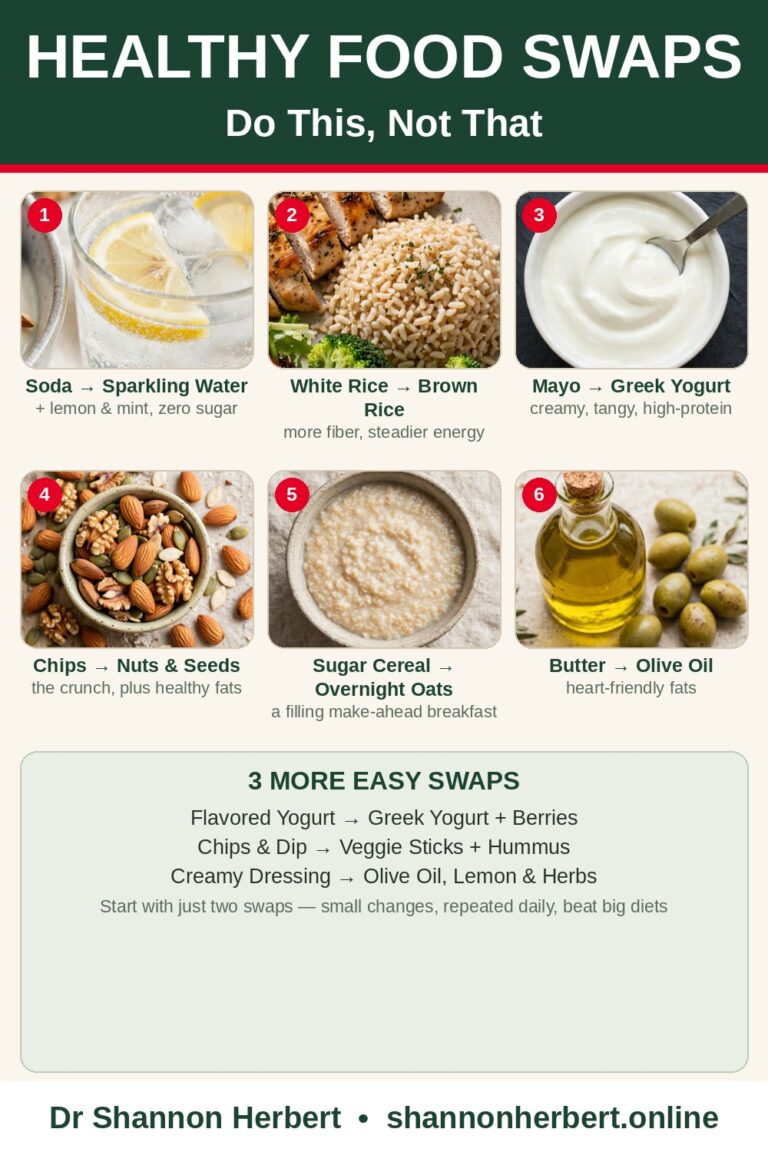
And when you want the treat version, use the smarter options in Do This, Not That: 8 Simple Food Swaps — a planned Greek-yogurt “ice cream” or yogurt parfait is a treat that does not undo the day.
The Bottom Line
Simple beats perfect. Pick two tips this week, make them routine, then add another. If you want a suggested order, most of our readers find this sequence easiest: start with Tip 3 (drinks — one change, immediate effect), add Tip 2 (protein at breakfast first, then lunch), then Tip 1 (the balanced plate) once protein is in place. Tips 4 through 7 layer in naturally after that.
Expect the change to feel undramatic. That is the sign it is working. Habits that will still be with you in five years do not feel like a boot camp; they feel like “just how I eat now.” That is how real change actually happens — in the kitchen and, as our Remedies readers know, in the remedy jar too: the same patience that ferments a jar of Fermented Pineapple Honey Remedy is the patience that builds a way of eating.
Frequently Asked Questions
Which single tip matters most?
For most people, Tip 3 — not drinking your calories — removes the most calories for the least effort. If drinks are already fine in your life, Tip 2 (protein at every meal) usually changes hunger the most noticeably.
How long before these habits feel automatic?
Research on habit formation suggests anywhere from a few weeks to a few months, depending on the habit and the person. Judge progress monthly, not daily.
Do I need to count calories alongside these tips?
Not necessarily. These tips are designed to reduce intake and improve quality without counting. Some people like a short period of counting purely as education — two weeks of tracking teaches portion sizes faster than anything — but it is a learning tool, not a life sentence.
What about weekends?
Apply the same defaults loosely, not rigidly. A plan that survives weekends at 70% beats a perfect plan that exists only Monday to Friday.
This article is for general information only and is not medical advice.