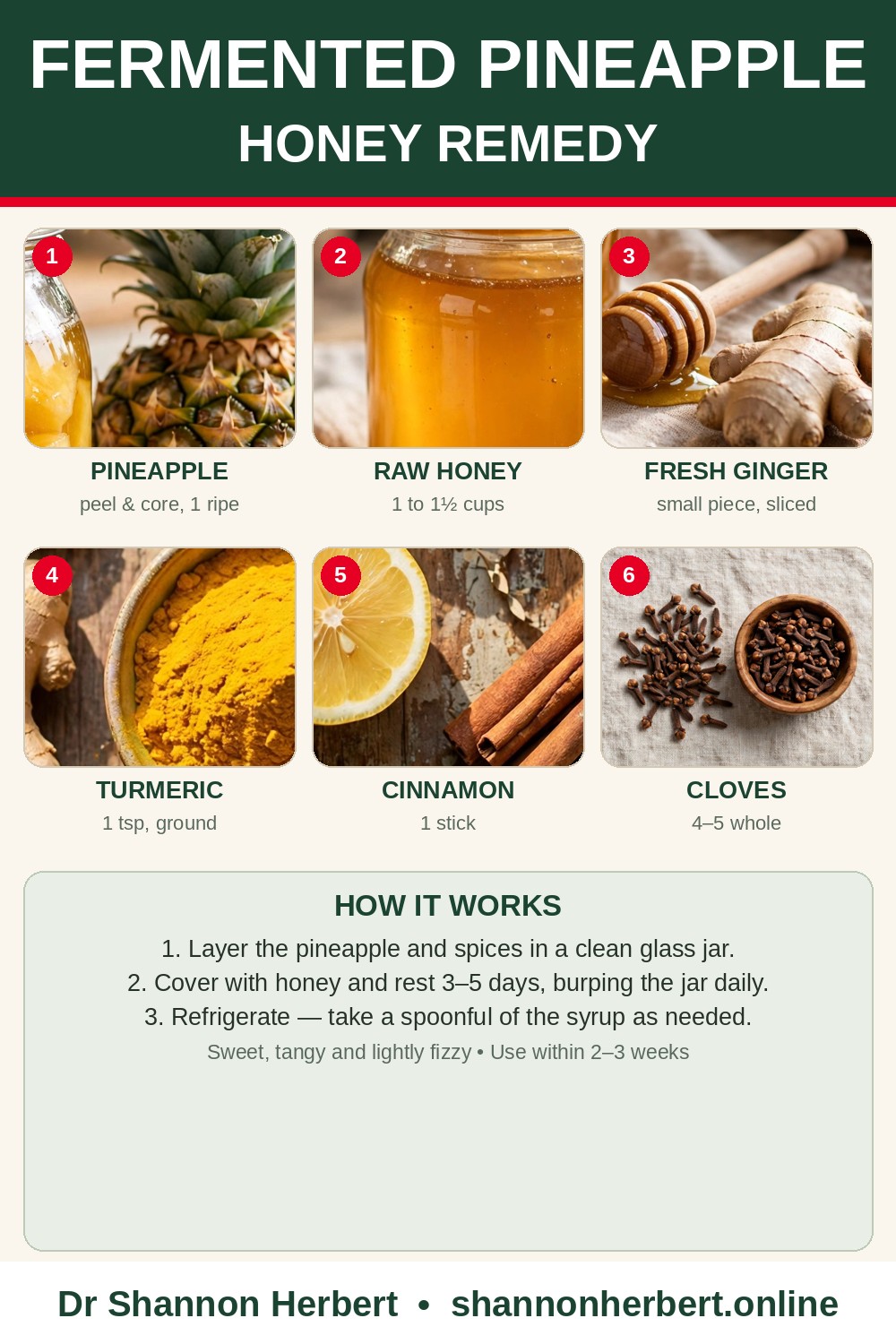
Fermented Pineapple Honey Remedy for Coughs and Colds
How to Store It, and How Long It Keeps
Refrigerate after fermentation and use within 2–3 weeks.
Keep the lid closed, store the jar toward the back of the fridge, and always use a clean, dry spoon. The flavor may taste a touch more tart in week two — that is normal. This is not a shelf-stable preserve. Do not can it or leave it back out on the counter. When in doubt about quality, discard it.
Troubleshooting: Too Sour, Mold, Kahm Yeast, and Alcohol Smells
Too sour or too sharp: The jar most likely fermented a little long, or your kitchen was warm. If it smells clean and fruity and shows no mold, it is not necessarily spoiled just because it is tangy. Refrigerate it right away, use smaller amounts in warm water or tea, or stir in fresh honey when serving. Next time, refrigerate a day earlier. If sourness comes with a rotten smell, treat it as spoiled.
Mold — always discard: Mold appears as fuzzy spots or patches — white, green, blue, black, or pink — usually on fruit exposed above the syrup. Do not scrape it off and keep the rest, and do not taste it to check. Mold in a liquid ferment cannot be safely cut away. Discard the whole contents and start again.
Kahm yeast — a common look-alike: Kahm yeast can form a thin, flat, white or cream-colored film on the surface, but without the fuzzy, raised, colorful look of mold. It often brings a yeasty, off flavor. Experienced fermenters sometimes skim a small film and continue, but for this beginner-friendly remedy the advice is simpler: if you see a film you cannot confidently identify, discard the batch.
Alcohol smell: A faint, wine-like note can appear, because yeast naturally produces a small amount of alcohol as it consumes sugars. That is different from a jar that smells strongly alcoholic, like spirits or nail polish remover. If the jar smells strongly alcoholic, moldy, or “off,” discard it and start again. Do not try to cook it off or dilute it, and never serve a questionable batch to children.
No bubbles at all: Check that you used raw honey, that the jar is not in a very cold spot, and that the pineapple was ripe and juicy. Give it one more day. If after 4 to 5 days there is still no activity and the fruit smells flat or unpleasant, discard it.
Fruit turning brown: Slight darkening where pineapple touches air is common. Extensive browning with a slimy texture or an off smell is not normal — discard the jar.
The rule that covers every situation is the oldest one in the kitchen: when in doubt, throw it out.
Common Mistakes to Avoid
- Using an unripe pineapple: Starchy flavor, little juice, and a slow ferment.
- Sealing the jar tightly and forgetting it: Gas builds up. Burp daily or leave the lid loose.
- Skipping the daily check: Floating fruit left exposed is the most common route to mold.
- Using a dirty spoon or jar: Clean equipment, and a clean spoon every time, are part of the recipe.
- Adding water: Let pineapple juice do the work instead.
- Leaving it out too long: Refrigerate when it tastes right.
- Expecting it to work like medicine: Treating it as a substitute for medical care is the most serious mistake of all.
Good to Know: Who Should Avoid It, and When to See a Doctor
- Never give honey to babies under 12 months old.
- If the jar smells strongly alcoholic, moldy, or “off,” discard it and start again.
- Refrigerate after fermentation and use within 2–3 weeks.
- A cough that lasts more than a week, or comes with fever or chest pain, needs a doctor — not another spoonful.
Some groups should be especially careful. People who are pregnant, have a weakened immune system, or have a serious long-term condition should ask their doctor before trying fermented home preparations. People with diabetes should remember that this syrup is concentrated sugar from honey and fruit, and ask their care team if unsure. Anyone with a pineapple, honey, or bee-product allergy should avoid this recipe entirely, and anyone who notices itching, swelling, or stomach upset after trying it should stop and seek advice if symptoms are more than mild.
See a doctor promptly if a cough lasts more than a week, keeps returning, or gets worse; if a fever is high or lasts more than a few days; or if you have chest pain, difficulty breathing, wheezing, or coughing up blood. Babies, young children, older adults, and anyone with asthma should be checked sooner.
Frequently Asked Questions
Do I have to use raw honey?
Raw honey is strongly recommended because its naturally present yeasts help fermentation begin reliably. Pasteurized honey may still ferment, but results are less predictable.
Can I use the pineapple core?
The core is edible but hard and fibrous, and it stays tough even after fermenting. Save it for smoothies. Use the tender flesh in the jar.
Why is my honey getting thinner?
That thinning is expected, and it is a sign things are working. Honey draws juice out of the pineapple, the extra water activates fermentation, and the syrup becomes pourable.
Is a little fizz normal?
Yes. Light fizz and small bubbles are the normal result of carbon dioxide from fermentation, and a gentle tang is expected. A strong alcohol smell, fuzzy mold, or slimy texture is not normal — those mean discard.
How much should I take, and for how long?
People traditionally take a spoonful of the syrup, or a few chunks, 2–3 times a day for a few days when a cough or cold shows up. It is a short-term comfort, not a daily supplement. If symptoms persist, the answer is a doctor visit, not a longer course of syrup.
Can I make a double batch?
Yes, in a larger jar, as long as you leave headspace and keep up the daily burping and pressing down. Many people prefer a single-pineapple batch, because it is used up within its 2 to 3 weeks.
What can I do with leftover chunks?
The soft, honeyed chunks are delicious over yogurt, in oatmeal, in a smoothie, or over ice cream. Keep them refrigerated and use them within the same window.
If jar remedies are your thing, you will love our Honey and Garlic Tonic too. And for a whole shelf of ideas, see 20 Natural Remedies You Can Make at Home.
This article is for general information only and is not medical advice.