Natural Remedies for Dark Spots and Uneven Skin Tone
Few skin concerns are as common — or as stubborn — as dark spots. A patch left behind by a healed blemish. Brown marks across the cheeks and hands that seem to arrive with the birthdays. An uneven tone that makes you reach for foundation on days you would rather not bother. If you have any of these, you are in very large company, and it is natural to wonder what gentle home remedies can do.
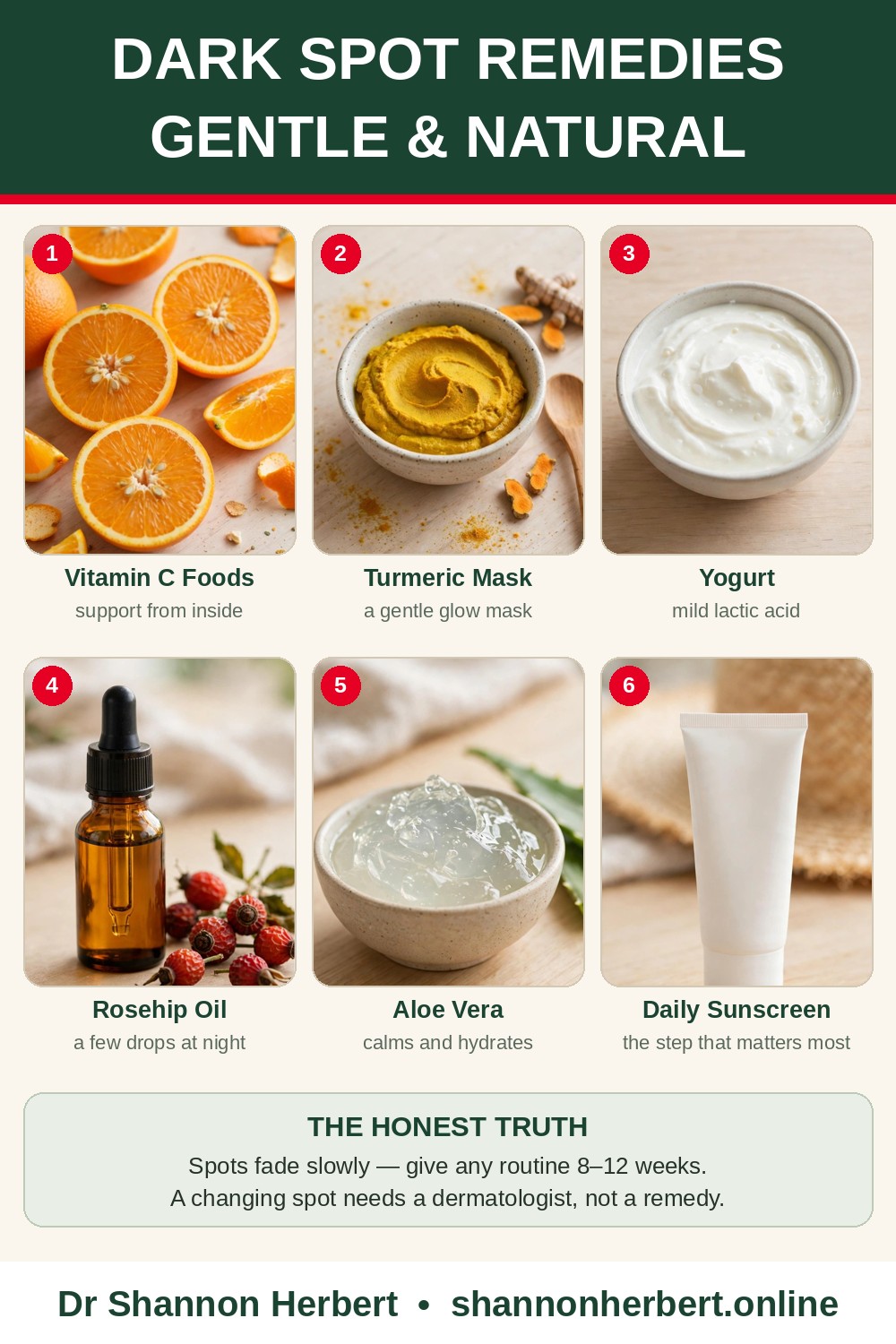
So let us be honest right from the start, because honesty saves money and disappointment. Dark spots fade slowly. Gentle natural remedies may soften the look of mild spots and help skin tone look more even over a period of weeks, especially when the marks are recent and superficial. They will not erase deep, long-standing pigmentation, and nothing you apply at the kitchen counter will out-perform the one unglamorous habit that matters more than all of them: daily sunscreen. This article explains why spots appear, walks through the gentle options people use and how to use them safely, and gives sunscreen the starring role it deserves.
Why Dark Spots Appear
Nearly all dark spots come down to one substance: melanin, the pigment that gives skin its color. Melanin is not the villain — it is your skin’s built-in sun defense, produced by cells called melanocytes to absorb ultraviolet light. Problems start when melanin is produced unevenly: too much in one small area, and a spot appears. The usual triggers are these:
Sun exposure. This is the biggest cause by far. When ultraviolet light hits skin, melanocytes make more melanin. Over months and years, that extra pigment can gather into flat brown marks — often called sun spots or solar lentigines — on the places that see the most daylight: the face, the backs of the hands, the shoulders, and the upper chest. They are, in effect, a record of your sunny days.
Age. So-called “age spots” are mostly the same thing as sun spots; they simply become more visible with time because the sun exposure behind them has been accumulating for decades, and because older skin is slower to renew itself and even out pigment. They typically appear after 40, though keen sunbathers can see them earlier.
Post-blemish marks. After a pimple, scratch, insect bite, rash, or any irritation heals, the skin sometimes leaves a flat brown or purplish mark behind. Dermatologists call this post-inflammatory hyperpigmentation. It is extremely common, particularly in medium and deeper skin tones, and it is not a scar — it is leftover pigment in the surface layers. The good news is that these marks usually fade on their own with time; the less good news is that “time” often means several months, and sun exposure can make them darker and longer-lasting.
Picking, squeezing, and scrubbing. Anything that injures or inflames the skin can leave a mark behind, which is why squeezing a pimple so often trades a one-week blemish for a three-month spot. Hands off is a genuine remedy here: let blemishes heal untouched, resist the urge to scrub marks away with harsh exfoliants, and calm irritation quickly and gently when it appears. The calmer your skin stays, the less excess pigment it lays down.
Hormones. Melasma is a pattern of larger, patchy pigmentation — often across the cheeks, forehead, and upper lip — linked to hormonal changes such as pregnancy or hormonal contraception, combined with sun exposure. It behaves differently from ordinary spots, tends to come back, and usually needs a dermatologist’s guidance rather than home experiments.
One more thing worth understanding: skin renews itself in a cycle of roughly four weeks in younger adults, and more slowly as we age. Pigment sitting in the surface layers is gradually carried up and shed as that cycle turns. That is why every honest remedy talks in weeks, not days — you are working with your skin’s calendar, not against it. A realistic way to judge any gentle routine is to take a photo in the same light once a month and compare over 8 to 12 weeks. It also explains why a mark can seem to vanish in winter and reappear across a summer: the pigment was never fully gone, and fresh sun quietly darkened what remained.
Marks also behave differently from person to person. In deeper skin tones, post-blemish pigment is often more intense and slower to fade, which is all the more reason to favor the gentle end of every remedy in this article — irritation that fair skin shrugs off in a day can leave a lasting mark on richer skin tones.
And a warning about what not to do: hard scrubbing, harsh DIY peels, and the popular lemon-juice-in-the-sun trick do not speed things up. Lemon juice on skin followed by sunlight can cause a blistering reaction (phytophotodermatitis) that leaves marks far worse than the one you started with. Irritation of any kind can trigger more pigment, which is the exact opposite of the goal. With dark spots, gentle beats aggressive every time.